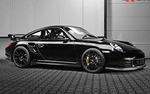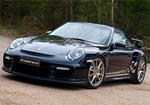

997 Porsche 911 GT2: the brochure has leaked !
Porsche Stability Management (PSM).
The 997 Porsche 911 GT2 has a specially adapted version of Porsche Stability Management (PSM). In addition to ABS, the package includes two automatic driver aids: stability control (SC) and traction control (TC).
Stability control (SC), which is responsible for lateral dynamics, uses a range of sensors to monitor the direction, speed, yaw velocity (speed of rotation around the vertical axis) and lateral acceleration of the car. Using this information, it is possible to calculate the actual direction of travel at any given moment.
If the car begins to oversteer or understeer, selective braking is applied on individual wheels to restore control at the optimum speed. Traction Control (TC), with its integrated ABD (automatic brake differential), ASR (anti-slip regulation) and EDC (engine drag control) functions, is responsible for the long dynamics of the car. Configured for sports or driving, traction control improves handling under acceleration on surfaces with inconsistent grip and also prevents the rear from 'stepping out' if it looses traction under full power.
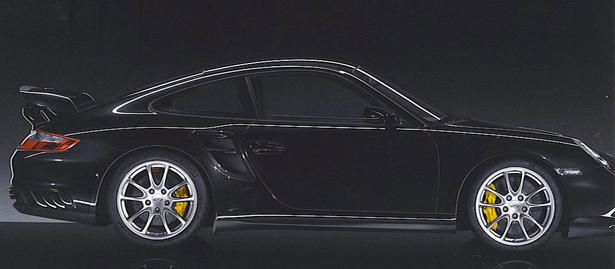
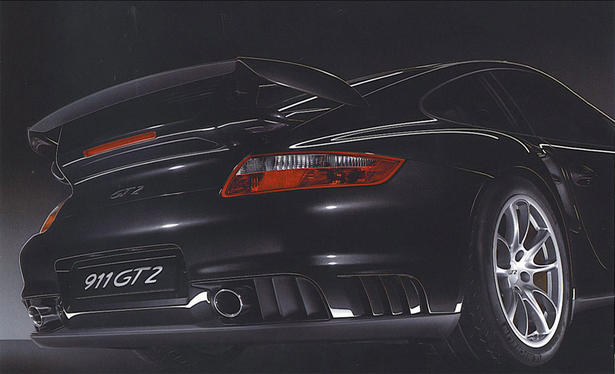
Designing a new 911 GT2 requires a new approach to old ideas. It means questioning convention, crossing the limits, thinking beyond the norm. It means not being confined to road or track, straight or bend, comfort or sports performance. It means having the freedom to leave what you know and examine new possibilities. The result is the most powerful road-going 911 ever made.
The source of that power is a 3.6 liter flat-six boxer engine based on the current 911 Turbo. Special features include VarioCam Plus and twin turbo-chargers with Variable Turbine Geometry (VTG) enabling faster response at lower engine
speeds. Together, they generate even greater power: a mighty 530 hp at 6,500 rpm.
Performance and efficiency have both been improved, mainly through changes to the turbo-charging system. The flow-optimized turbines and compressor units have been specially adapted to the engine output and offer a more effective turbocharging process. In addition, the new 997 Porsche 911 GT2 has an ‘expansion’ intake manifold – a totally new technology that is radically different to the existing induction principle for turbocharged engines. Another improvement is the higher rate of
exhaust flow through the new main silencer – now made from ultralight weight titanium.
Rear-wheel drive provides driving dynamics that are similar to those of a racing car. The light-weight build keeps the overall weight low for a power-to-weight ratio of 5.99 lbs/hp.
For some, that number means little on paper – but it all becomes clear on the road. With a driving experience – and an engine sound – that can only be conceived in the 997 Porsche 911 GT2.
For some, the aim is high performance. For us, that’s merely the result.
At Porsche the aim is not to increase power – except through increased efficiency. Which is why they began with the 911 Turbo when developing en engine for the new 997 Porsche 911 GT2. Its power is combined with rear-wheel drive for racing car driving dynamics.
The six cylinder boxer unit has flow-optimized turbines featuring Variable Turbine Geometry (VTG) and larger compressors on the intake side. Together with VarioCam Plus, they boost performance while reducing emissions over the entire engine speed range. Other important features include the revolutionary new expansion intake manifold, dry-sump lubrication with external oil reservoir and the new titanium main silencer.
The result: 530 hp from a 3.6 liter displacement at 6,500 rpm. Maximum torque of 505 lb-ft is available from 2,200 to 4,500 rpm. The bench-mark sprint 0-60 mph is completed in 3.6 seconds; 0-100 mph requires just 7.4 seconds and top track speed is 204 mph.
Technical specifications:
- Cylinders: 6
- Displacement: 3,600 cc
- Power: 530 hp at 6,500 rpm
- Torque: 505 lb-ft
- Transmission: rear-wheel drive, 6-speed
- Weight: curb weight 3,175 lbs, gross vehicle weight rating 3,858 lbs
- Performance:
- Top Track Speed: 204 mph
- 0 – 60 : mph: 3.6 sec.
- 0 – 100mph : 7.4 sec.