
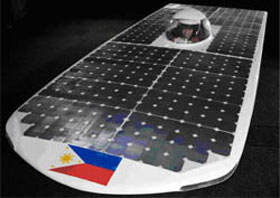
The Sinag Solar Powered Car was developed by students from the Mechanical Engineering and the Electronic and Communications Engineering Departments of De La Salle University-Manila, headed by Prof. Rene Fernandez. The Sinag Solar Powered Car was built with the support of De La Salle University-Manila, Ford Group Philippines, Motolite, Philippine Airlines, San Miguel Corporation, Shell, SunPower, and Ventus.
Ford Press Release:
A SHINING BREAKTHROUGH: SINAG SOLAR POWERED CAR REVEALED
A new dawn breaks in the race for sustainable energy as SINAG, the first Philippine
solar-powered car to participate in the World Solar Challenge in Australia, was unveiled on September 1, 2007 at One Esplanade, SM Central Business Park, Pasay City.
SINAG is the embodiment of a threefold message: that the Philippines is blessed with great potential for tapping renewable energy sources such as solar power; that the Philippines produces some of the most efficient solar cells in the world; and that we as a nation can stand alongside the rest of the world in developing solar power technology. By undertaking this global challenge,
SINAG takes us one step closer to finally harnessing the full power of the sun.
SINAG was designed and constructed by students from the Mechanical Engineering and the Electronic and Communications Engineering Departments of De La Salle University-Manila, headed by Prof. Rene Fernandez, the Overall Technical Team Leader, with the support of sponsors De La Salle University-Manila, Ford Group Philippines, Motolite, Philippine Airlines, San Miguel Corporation, Shell, SunPower, and Ventus.
They are also joined by Aurora, Cabrera Lavadia and Associates, JWT, Creasia, Merritt Partners, Tuason Racing School, Gochermann Solar Technology, and Stratworks.
The public unveiling of SINAG is supported by One Esplanade and SM Investments Corporation.
SINAG will join other solar power champions in the prestigious World Solar Challenge from October 21 to 28, 2007.
Competing with the best of the world
The World Solar Challenge is the ultimate test in the efficient use of the sun as a source of sustainable energy, requiring delicately balanced speed and endurance, energy management, and strategic planning. The objective of this competition is to build a solar-powered vehicle capable of undertaking the 3,000-kilometre journey across Australia, from Darwin to Adelaide.
The competition also aims to work for a clean and green environment by motivating research and development for alternative power sources. Since Danish adventurer Hans Thorstrup’s introduction of the competition in 1987, more than 300 entries
from all over the world have joined this remarkable journey.
SINAG and other competing solar cars will be provided with workshops on October 8, while the test track will be available to them from October 15 onwards. The vehicles will be registered on October 18. The race will commence on October 21, with the awards rites on the 28th.
Fueling the nation
The interest in the development of sustainable energy is a growing trend in business the world over, as shown by the willingness of diverse private groups to work together for the common good. The drive for this cause has been so great that representatives from SINAG’s sponsors have banded together to form the Philippine Solar Car Challenge Society, Inc., (PSCS) with the aim to launch and pursue other projects that will similarly spotlight the potentials of solar energy and the Filipino capacity to harness it for the benefit of the country. The PSCS further aims to show that by working together, we as a people have what it takes to develop solar power as a viable renewable power source.
For decades, solar power as a practical source of sustainable energy has been an elusive goal. Thankfully, because of the efforts of the people behind SINAG, the first Philippine entry to the World Solar Challenge in Australia this October, the future of a clean, pollution-free energy source shines brighter than ever. Along the way, they are counting on the feat to bring pride to Filipinos and, hopefully, inspire other people to rally behind this cause and be champions for the environment.
ABOUT THE SINAG SOLAR POWERED CAR
SINAG DISPLAYS FILIPINO BRILLIANCE & INGENUITY
SINAG, the Philippines’ first solar-powered car to participate in the World Solar Challenge, radiates with homegrown Filipino talent in every aspect of its design. The 150kg car’s unassuming, wing-like profile belies the cutting-edge technologies tucked away inside. Discreetly hidden under its slender white hull is a maze of mechanical and electronic components that ensure that the car makes it through its grueling 3,000km journey across Australia’s hot desert flats in the upcoming 20 th World Solar Challenge this October.
“The car has three major parts: the mechanical system, the electrical system, and the shell,” Prof. Rene Fernandez, Team Sinag’s overall technical team leader, explains. “All of these elements work together to keep the car going.”
Steering made simple . Nothing could be more straightforward than SINAG’s mechanical system. Eschewing the common steel chassis and “double wishbone” front wheel suspension system used on conventional cars, it favors an ultra-light monocoque frame with three wheels – one heavy-duty rear wheel to drive the car forward, and two front wheels to steer. Amazingly, in yet another nod to Filipino ingenuity, SINAG’s steering system consists of surplus motorbike front forks and wheels – the same kind found on public utility tricycles.
Inside, the driver sits at a comfortable reclining angle of 27 degrees and is safely protected by a rollbar cage. The instrumentation is just as uncomplicated, with gauges for pedal pressure, speed, and battery power, plus a cruise controller on its uncluttered dashboard.
A power balancing act . On top of SINAG’s shell is the most distinctive part of the car and the most visible part of its electrical system: the 400 solar cells that generate a combined output of as much as 2kW. Proudly Philippine-made, these industry-leading model A-300 solar cells from SunPower boast the highest efficiency of any commercially available solar cell in the world. The monocrystalline silicon structure of SunPower’s cells and their exclusive back-contact technology give them a distinctively smooth black surface, which helps them convert more of the sun’s energy into electrical energy than conventional cells do. Each cell has an efficiency of as much as 21%, whereas other commercial cells are rated from 15% to 17% at most.
The solar cells, connected in series to form a large solar array, are hooked up to the car’s electrical system and power the rear-wheel motor to propel the car forward at speeds of up to 100km/h. The car’s electrical system also includes Kokam Lithium Polymer batteries that store excess power generated by the solar cells, which could later be tapped by the motor when there is a sudden reduction in the amount of energy received from the sun – as in the case of a transient thick cloud cover. The 120v batteries can be charged to full capacity in 5 hours and can continuously power the car running at top speed for 4 straight hours.
This whole power balancing act is orchestrated by SINAG’s electrical system, which regularly monitors its power requirements and keeps track of how much solar power is being collected, how much power is stored in the onboard battery, how fast the driver wants to go, and other variables. There’s even a telemetry system that constantly sends data on the car’s health via radio to two support vehicles that will travel alongside SINAG.
It’s all in the shell . The shell or hull, even though it has no moving parts, was actually the most difficult aspect of the car to design and build. Getting the right shape was crucial for the SINAG team because it would greatly affect the performance of the whole car: too small and there might not be enough space to put in the solar cells to power it; too big and it would be sluggish and waste too much energy as it moved forward. Having a curve in the wrong place creates a dragging effect when the car moves forward at high speeds, thereby slowing it down.
“We did a lot of research and used computer models to determine the right shape. We came up with one that’s very aerodynamic, with a 0.1 drag coefficient,” says Fernandez. The smaller the drag coefficient, the less energy would be needed to move the car forward. In contrast, an average car on the road has a drag coefficient of 0.3.
The hull is made of pre-scored Termanto PVC boards covered with carbon fiber weave, which would make the car strong yet as light and flexible as possible, helping to further reduce its power needs.
Racing the sun. Designed and constructed from Philippine-made materials by a passionate all-Filipino team, SINAG is solid proof of how far a nation can go to achieve a promising and clean future.
For months, mechanical engineering and e lectronic & communications engineering students from De La Salle University – Manila laboriously designed and constructed this revolutionary vehicle, determined to complete the World Solar Challenge in Australia, and prove to the world that the Filipino can stand shoulder to shoulder with other progressive nations in developing solar power as an environmentally-safe, alternative energy source.
The noble endeavor is supported by major sponsors De La Salle University - Manila, Ford Group Philippines, Motolite, Philippine Airlines, San Miguel Corporation, Shell, Sunpower, and Ventus.
The project is also supported by Aurora, Cabrera Lavadia and Associates, JWT, Creasia, Merritt Partners, Tuason Racing School, Gochermann Solar Technology, and Stratworks.