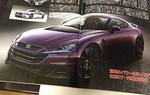

The Nissan GT-R drivability was tested in the development stage in four different types of scenarios: circuit, high-speed, slippery road conditions (snow and rain) and daily driving.
The circuit stage of testing was of course done on the famous Nurburgring race track in Germany. The Nissan GT-R undertook around 5000 km (3107 miles) of high-speed testing and consistently achieved lap times of just under 8 minutes.
One of the most interesting tests the
Nissan Press Release:
Circuit:
Racing circuit testing was undertaken primarily at the Nordschleife, the historic section of the famous Nürburgring circuit in Germany. This fast, undulating, supremely challenging circuit, regarded as the world's most demanding racing track, is widely used by car and tire companies for testing.


The Nissan GT-R undertook about 5000 km (3107 miles)of high-speed testing at the Nürburgring, and was consistently achieving lap times of just under 8 minutes.
Extensive testing was also undertaken at Japan's demanding Sendai track that, like the Nürburgring, features undulations, a mix of fast and slow corners, and is regarded as an especially taxing and difficult course. Most racing circuits were avoided. 'They were too easy,' says Kazutoshi Mizuno, chief vehicle engineer for the Nissan GT-R.
High speed driving:
One of the many unusual tests that the Nissan GT-R had to pass, before going on sale, was to be able to cruise at 300 km/h (186.4 mph) and allow easy conversation - without the raising of voices - between the two front seat passengers. 'The car has to be easy and relaxing to drive fast,' says Mizuno. 'It has to be no-fuss - even at 300 km/h/'.
Several locations were chosen for high-speed performance testing. Stretches of German Autobahns, where there are no speed limits, were used regularly. 'They are the best real-world testing laboratories available,' says Mizuno. The Nissan GT-R was able to meet its goal - quiet, fuss-free 300 km/h performance - thanks to its superb aerodynamics, precise alignment of body panels and its advanced technologies.
Snowy and Rainy conditions driving:
When it snows or rains, many supercars are left in the garage. Not the Nissan GT-R. When it rains or snows, the Nissan GT-R shines. While the Nissan GT-R has a clear advantage over most rival supercars on a racing circuit or at high-speed on
the public roads, its superiority in difficult conditions - ice, rain, slush, snow - is far more noticeable. This is because of its advanced four-wheel drive system, which offers unmatched traction and handling security, and the perfect weight distribution across the four corners of the car.
Daily driving:
Most supercars feel like caged animals in the city - ill-tempered and frustrated by traffic and poor road surfaces. Not the Nissan GT-R. A simple touch of the set-up switch softens the suspension, turning this extraordinarily fast vehicle into a supple, comfortable coupe. You can even choose full automatic transmission, for an even easier ride.