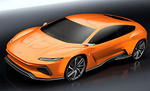

The North American and Japanese brands are represented at the 2008 LA Design Challenge by the Chaparral Volt, the Honda Great Race, the Mazda Kaan, Mitsubishi MMR25 and the Toyota Lemans Racer.
The Honda Great Race 2025 is not just a car design, but a racing concept. The 24-hour race will take the drivers around the world, over 22,000 miles. The cars sensors will be able to detect the type of surface the vehicle is on and adjust it accordingly.
The Mitsubishi MMR25 is equipped with multi-terrain, omnidirectional wheels that allow the car to go forwards while pointing in any direction.
from the LA Auto Show press release:
GM Chaparral Volt
General Motors Advanced Design, California
Designed for the 2025 revival of the LA Times Grand Prix, the Chaparral Volt uses advanced EREV propulsion, energy collection, generation and management system to create an entirely new category
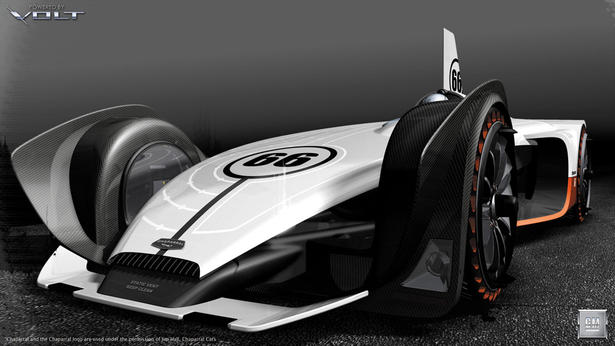
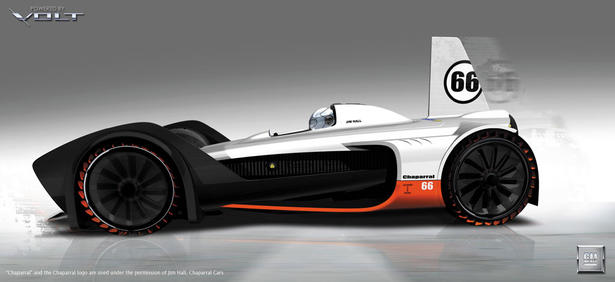
of racing - the eco-triathlon.
The Chaparral Volt collects and generates its own energy from three different clean, renewable and abundant California resources: Earth, Wind and Fire.
Earth (Geologic) Gravity and momentum-capture regeneration and aero-thermal resistance provide astounding levels of braking efficiency in addition to active energy regeneration.
Wind (Aero-Thermal) Building on the legendary Chaparral 2J, the Volt utilizes rear turbine
extractors for power cell cooling, down force and (in reversed direction) a combination of aero-assist braking and energy regeneration.
Fire (Radiant Sunlight) Integrated thin-film PV panels for the racer’s body and team support unit takes advantage of Southern California’s most abundant resource, the sun, and converts it for use as the Chaparral Volt’s primary energy source.
Design Team:
Frank Saucedo, Steve Anderson, Thamer Hannona, Jussi Timonen, Loren Kulesus, Alessandro Zezza, Sean Moghadam, Tony Liu and Phil Tanioka
*“Chaparral” and the Chaparral logo are used under the permission of Jim Hall, Chaparral Cars
Honda’s The Great Race 2025
Honda Research and Development
In 1908, 17 men dared to take on the “toughest race ever devised.” Spanning six months, the Great Race brought these men over 22,000 miles, through three continents and around the world. 117 years later, the Great Race of 2025 is tougher than ever.
Competitors must circumnavigate the globe in 24 hours on land through the United States, by sea through Asia and by air over Europe.
The vehicle’s sonar/echolocation sensors are able to detect changes in speed, terrain, and altitude, allowing it to switch to any configuration. With expertise in automotive, marine, robotics, and jet technologies already in place, Honda possesses a distinct, competitive advantage over its rivals, allowing it to lead in the evolution of motorsports in the 21st century.
Design Team: Franco Corral
MAZDA KAAN
Mazda Research and Development
The MAZDA KAAN is an electric race car designed to compete in the E1 races, the pinnacle of international motorsports in terms of technology and popularity. In 2025, California freeways have been resurfaced with a sub-level electro-conductive polymer that powers the electric cars of the modern world. MAZDA’s patented electronic tire system uses this technology to power the KAAN to reach 250 mph with no harmful emissions!
The vehicles are piloted by individual drivers but teams are made up of thirty cars, all on the track together. Using strategies similar to those in cycling peletons, the tighter the group sticks together, the more aerodynamic and powerful it becomes.
Inspiration for the KAAN comes from electric fields and textures seen in nature, particularly those in a lightning bolt. The car is uniquely designed around its powerful electric wheels while the cockpit acts as a capsule to safely house the driver, allowing for tighter peloton formations and a team victory.
Design Team:
Jacques Flynn
Carlos Salaff
Minyong Lee
Greg Lee
Tim Brown
Jordan Meadows
Mitsubishi Motors MMR25
Mitsubishi Research & Design of North America
Mitsubishi breaks from convention and introduces the MMR25.
While the look is shocking, the multi-terrain, omnidirectional wheels consist of eight independently-controlled motors, allowing for “8 x 4” wheel drive so that the car can be driven forward while pointing in any direction. The MMR25 drives sideways into a corner and points the nose of the car outwards before even reaching the apex of the curve while driving sideways or backwards.
The MMR25 also uses special Oblique Aerodynamics to give the vehicle aero advantages. The center wing acts as a spoiler, actuated by pneumatic and fabricated from Memory Metal Alloy while the front and rear spoilers double as suspension blades which are able to control stiffness and ride height.
Design Team:
Jon Hull (design, surfacing, rendering and animation)
Toyota Lemans Racer
Calty Design Research, Inc.
Technological superiority and endurance creates the ultimate race car that never needs to stop. Not only is the racer powered by highly efficient hydrogen fuel cell electric motors, each of its body panels is embedded with photovoltaic panels that supply electricity when extra energy is needed.
The vehicle features two basic modes: High Speed Mode and Cornering Mode. In High Speed Mode, the body and wheels narrow, creating less drag and resistance to reach its highest speed of 350 mph. The Cornering Mode transforms the body to create a wide and stable stance with expanded wheels, establishing maximum contact and grip through tight turns.
To aid the driver in darkness or unreliable weather, the cockpit is a completely digital environment with a display enhanced by virtual reality, computer trajectory plotting, collision avoidance assistance and a robot co-pilot, which manages the on-board systems and repairs so that it can maintain full speed all the way to the finish.
Design Team:
President: Kevin Hunter
Studio Design Manager: Erwin Lui
Senior Creative Designer: Craig Kember